de La Roij G, van der Meijden RHM, Rutten L, Hoogstraten CA, Hinnen M, Martens S, Hoenderop JGJ, de Baaij JHF. Citrate modulates calciprotein particle formation and composition. Am J Physiol Renal Physiol. 2026 Mar 1;330(3):F313-F325.
Abstract
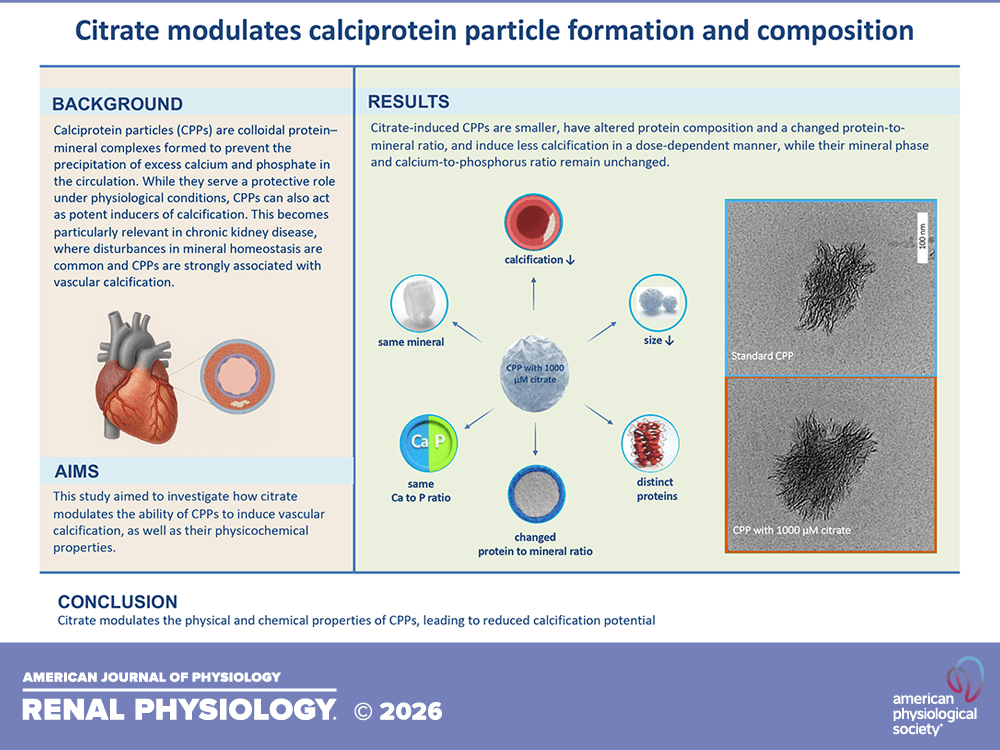
Chronic kidney disease (CKD) is a risk factor for cardiovascular disease (CVD), partly due to phosphate-induced vascular calcification. Fetuin-A stabilizes calcium-phosphate complexes into calciprotein particles (CPPs), preventing precipitation, but CPPs can mature into crystalline particles that drive calcification, particularly in CKD. In this study, we investigated whether citrate, a calcium chelator, could mitigate CPP-induced vascular calcification in vitro. Vascular smooth muscle cells (VSMCs) were incubated with CPPs containing varying citrate concentrations. We quantified calcification using calcium assays and characterized CPPs using spectrophotometry, dynamic light scattering, cryogenic transmission electron microscopy (cryo-TEM), electron diffraction (ED), Raman spectroscopy, energy dispersive X-ray spectroscopy, and mass spectrometry (MS). The highest citrate concentration, reduced calcification by 88% versus standard CPPs (P < 0.0001). CPP maturation was delayed, and mean diameter was 9% lower (216 ± 2 nm vs. 236 ± 6 nm; P = 0.0022). Cryo-TEM showed a transition from primary to secondary CPPs with preserved morphology. Hydroxyapatite was detected by ED in the standard and high-citrate CPPs, with the latter showing a significant lattice shift. An increased mineral-to-protein ratio was observed by Raman spectroscopy and protein-to-calcium assays. EDX demonstrated unchanged Ca/P ratios, but differences were observed in Ca (P = 0.0003), P (P < 0.0001), Na (P < 0.0001), and Cl (P < 0.0001). Finally, proteomics revealed 18 proteins enriched in standard CPPs (fold-changes -1.2 to -3.4; FDR < 0.05), including lipid-related apolipoproteins APOM, APOA1, APOA2, APOC3, and APOE. These data indicate that citrate remodels CPPs toward a less calcifying phenotype, highlighting its potential as a therapeutic strategy against vascular calcification in CKD.

