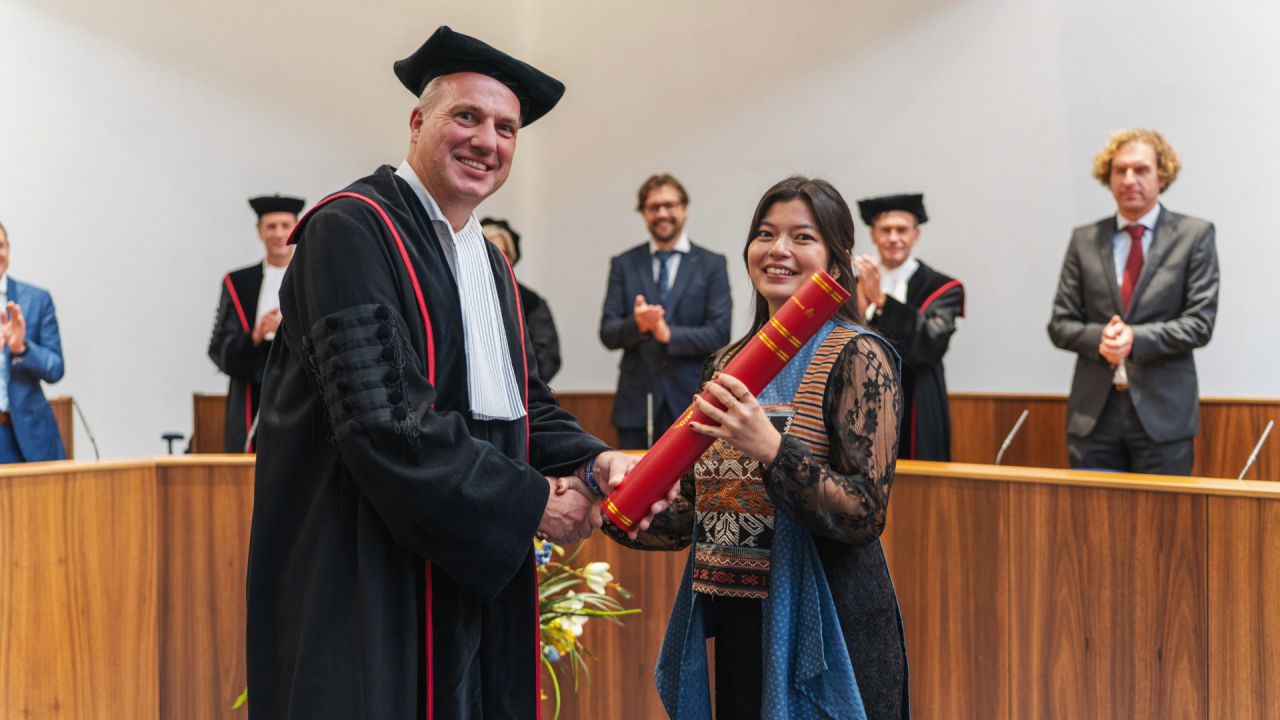
Anastasia Adella successfully defended her thesis entitled ‘Beating ADKH-RRAGD: The role of the mTORC1 signaling pathway, and therapeutic perspectives’.
Outline of this thesis
This thesis aimed to unravel the molecular mechanisms contributing to kidney tubulopathy and DCM in ADKH-RRAGD patients while identifying potential therapeutic approaches. To achieve this, the effects of RRAGD variants on mTORC1 signaling were examined. It is hypothesized that these variants lead to the overactivation of both canonical and non-canonical mTORC1 signaling. Subsequently, the consequences of the variants on kidney and heart function at both cellular and organismal levels were studied. Ultimately, this thesis highlights the importance of RagD in the heart and kidney, as well as in health and disease. Looking toward future patient care, the results of this thesis will assist in diagnosing more ADKH-RRAGD patients who may currently be undiagnosed and will further lay the groundwork for providing more precise medication for these patients. Chapter 2 describes a new cohort of ADKH-RRAGD patients with various novel and previously identified RRAGD variants. Here, the effects of the variants on mTORC1 signaling were examined using an in vitro model. Moreover, patients’ responses to the diuretics furosemide and hydrochlorothiazide were assessed. Lastly, as a potential treatment approach, the effects of dapagliflozin on serum Mg2+ levels in ADKH-RRAGD patients were examined. In chapter 3, using zebrafish embryos, the RRAGD p.(Ser76Leu) and p.(Pro119Arg) variants were modeled to study the effects of the variants on zebrafish heart and kidney function. Furthermore, the impact of rapamycin treatment in this model was investigated. Chapter 4 aimed to further delineate the molecular mechanisms underlying DCM in patients with the most prevalent RRAGD variant, p.(Ser76Leu), using an in vitro model. In this chapter, a human induced pluripotent stem cell-derived cardiomyocyte (hiPSCCM) cell line carrying the RRAGD p.(Ser76Leu) (c.227C>T) was generated and characterized. Furthermore, the effects of the variant on mTORC1 signaling were assessed.
Biography
Adella commenced her doctoral research at Radboudumc under the guidance of Prof. Dr. Joost Hoenderop and Dr. Jeroen de Baaij, co-supervised by Dr. Pieter A. Leermakers. Her doctoral research integrates her interests in rare diseases and cellular signaling pathways, focusing specifically on the role of the mTORC1 signaling pathway in the pathogenesis of autosomal dominant kidney hypomagnesemia linked to RRAGD variants.

