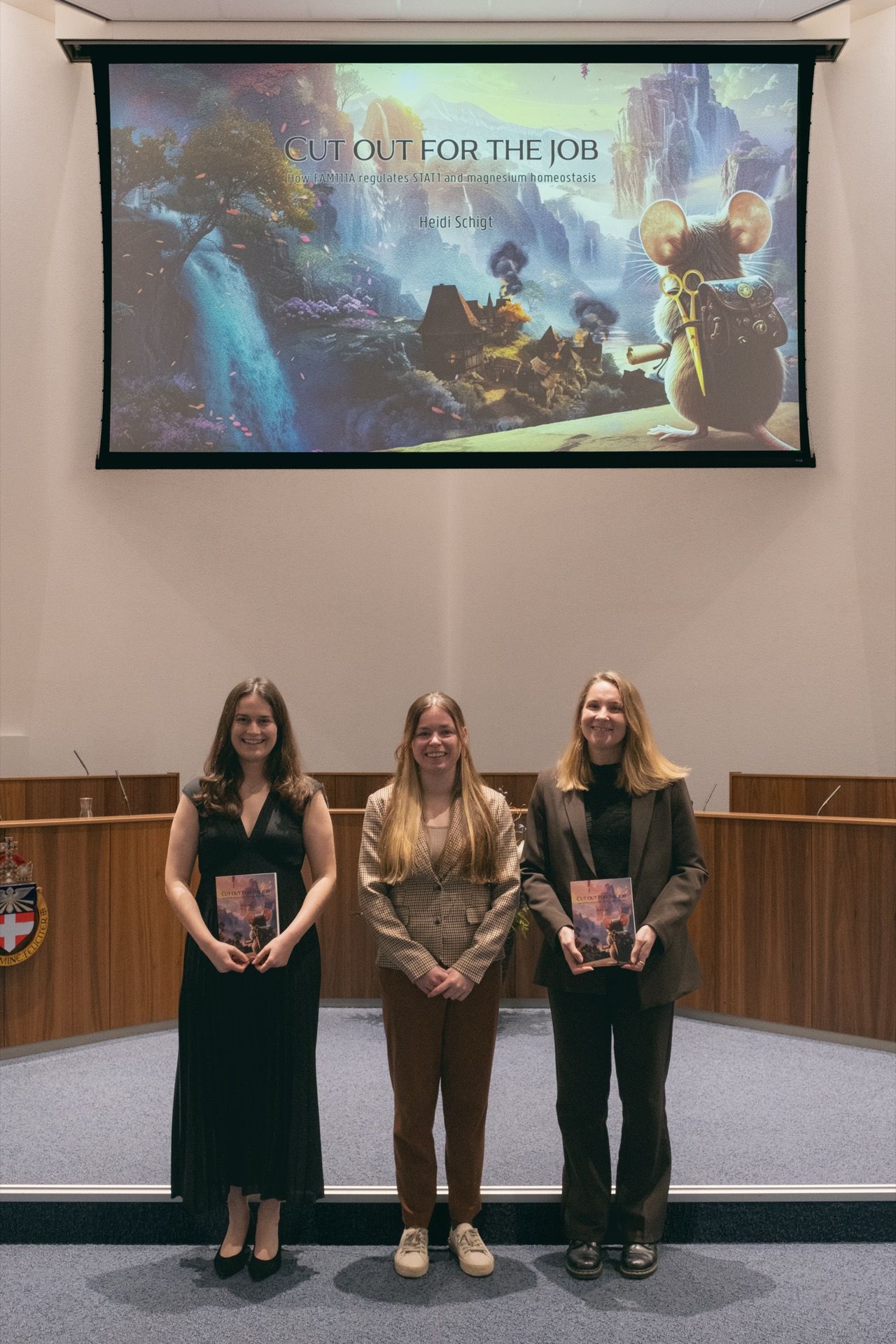
Heidi Schigt successfully defended her thesis entitled ‘Cut out for the job: how FAM111A regulates STAT1 and magnesium homeostasis’.
Outline of this thesis
Because KCS2 is a very rare disorder, KCS2 case reports were limited and, as a result, there was no clear consensus on the symptoms specific to the syndrome. In chapter 2, we aimed to overcome this limitation through a case series describing ten additional patients, and reviewing the existing literature. Subsequently, we wanted to gain a better understanding of which pathways are responsible for the electrolyte disturbances observed in these patients. We used Fam111a knockout mice in chapter 3 to analyse the effects on the skeleton, parathyroid gland, kidneys and intestines. Previously, FAM111A was shown to interact with signal transducer and activator of transcription 1 (STAT1) 38, but this interaction was never functionally characterised. We aimed to do this in chapter 4, where we looked at the effects of FAM111A on STAT1 activity. In a recent study, magnesium was found to be required for proper functioning of cytotoxic T lymphocytes 39. Thus, we set out to investigate the role of magnesium in STAT1 regulation in immune cells in chapter 5. Vice versa, we wondered if STAT1 could be important for the maintenance of magnesium homeostasis, which could potentially explain hypomagnesemia in KCS2. We tested this hypothesis in chapter 5 with patients with inborn errors of immunity and Stat1 knockout mice receiving injections of interferon gamma (IFN-γ), a cytokine that activates STAT1 through phosphorylation by Janus kinases (JAKs). Finally, in chapter 6, the work is placed in a broader context and discussed, and in chapter 7 the findings are summarised.
Biography
Heidi Schigt is a PhD candidate at the Department of Physiology, Radboud University Medical Center, Nijmegen, The Netherlands. His PhD research focuses on the regulation of renal Magnesium transport in health and rare monogenetic tubular disorders under the supervision of Prof. Dr. Joost Hoenderop and Dr. Jeroen de Baaij.
 Kidney Physiology